ADHD
ADHD time blindness: why time vanishes and how to fix it
Why ADHD time blindness makes hours vanish, what the research shows, and practical tools that make the clock visible so you stop running late.

You sit down at 2:15 pm to answer one email. You look up and the room is dark. The clock says 6:40. You missed an appointment, your tea went cold hours ago, and the afternoon left almost no trace in memory.
If that's familiar, you're not alone. It happens all the time to people with ADHD, and for years it got read as laziness or disrespect.
The research points somewhere else. In a 1997 paper in the Journal of Developmental & Behavioral Pediatrics, psychologist Russell Barkley argued that ADHD disrupts the brain's sense of time. Later lab studies backed up the basic finding: people with ADHD tend to estimate and track time less accurately. It's not a choice. It's how the clock works in your head.
What is time blindness?
Time blindness is a plain-language label, not a diagnosis. It describes how hard it can be to feel time passing without an outside cue.
A handy way to picture it is nearsightedness for time. What's happening right now feels vivid and urgent. A deadline three weeks away feels like a rumor. Barkley's 1997 theory ties this to executive function: working memory is what lets you hold the past in mind and weigh future consequences, and when it's weak, the room in front of you wins.
For many people with ADHD, the day sorts into two buckets: now and not now. A project in "not now" produces almost no pull to start, which feeds ADHD paralysis.
What does brain research say about time perception?
Timing differences in ADHD show up in lab tests, not just in self-reports.
A 2023 review in the International Journal of Environmental Research and Public Health, written by Christian Mette, looked at a decade of research on adults with ADHD. The studies covered three kinds of timing tasks:
- Time estimation: guessing how many seconds or minutes have passed.
- Time reproduction: holding a button down for as long as a tone lasted.
- Time discrimination: deciding which of two sounds was longer.
Across these, adults with ADHD tended to do worse than controls, though the review notes that the number of studies is limited. It also describes a longitudinal study that followed 158 children with ADHD for more than 20 years. The children made more errors on time reproduction, and that pattern stayed stable into adulthood.
Brain imaging offers a partial explanation. A 2013 review by Valdas Noreika, Christine Falter and Katya Rubia in Neuropsychologia summarized neuroimaging work on timing deficits in ADHD, pointing to brain circuits involving the frontal lobes, the basal ganglia and the cerebellum.
One small magnetoencephalography study (Wilson and colleagues, 2013) asked people to estimate 60 seconds repeatedly. Unmedicated participants with ADHD were less accurate than controls and showed weaker gamma activity in the anterior cingulate and left prefrontal cortex. After taking medication, their timing improved, and the improvement tracked small increases in that gamma activity. A 2019 review in Medical Science Monitor (Ptacek and colleagues) likewise notes that time perception tends to normalize with medical treatment. Neither tells you what will happen for you. A clinician can.
What does time blindness look like day to day?
It looks like a chain of small misjudgments.
Say you need to leave at 8:00 and it's 7:30. "A shower takes five minutes, I'm fine." Your brain skips the hidden steps: finding clothes, drying off, feeding the cat, hunting for keys. The shower took seven minutes. The routine took thirty-five. You're late again and baffled.
Switching tasks is another snag. Pulling yourself out of an absorbing article to start dinner takes effort, and without a felt sense of the schedule, you put it off until panic does the pushing.
It strains relationships too. Friends read lateness as disrespect, when you may have been scrambling to be ready and got pulled into "one quick chore" two minutes before leaving.
Some people overcorrect. They arrive forty-five minutes early everywhere and sit in the car, because any activity in between risks losing the hour entirely.
How time blindness shows up at work
At the office it gets mistaken for not caring.
Take a project estimate. Your manager asks, you say Friday, and on Monday Friday feels infinitely far off. The hours of research, edits and review don't register. By Thursday evening you're sprinting on adrenaline.
Calendar alerts don't fix it alone. The pop-up appears ten minutes before a call, you dismiss it to finish a sentence, and the meeting vanishes from your head. Twenty minutes later someone's asking where you are.
Standard advice says try harder. That's like telling someone with astigmatism to squint harder. You need systems that put the clock where your eyes already are.
Why might an analog clock beat digital numbers?
A digital clock shows a label. 2:40 tells you where you are, not how much afternoon is left before a 3:15 meeting. To work that out you have to do subtraction, and that's exactly the kind of step that gets skipped when working memory is stretched.
An analog face turns time into space. The minute hand sweeps a circle like a pie chart. If it's at the 8 and your meeting is at the 12, you don't calculate anything. You see a third of the circle left.
We'd suggest trying a silent analog clock in the rooms where you lose track most, typically the kitchen and your desk. We haven't found a study showing analog clocks help ADHD specifically, so treat it as a cheap experiment. It costs little and takes seconds to set up.
What tools make time visible?
The usual workaround is to move time out of your head and into the room, right where the work happens. These timers and planning apps can help.
1. Visual countdown timers
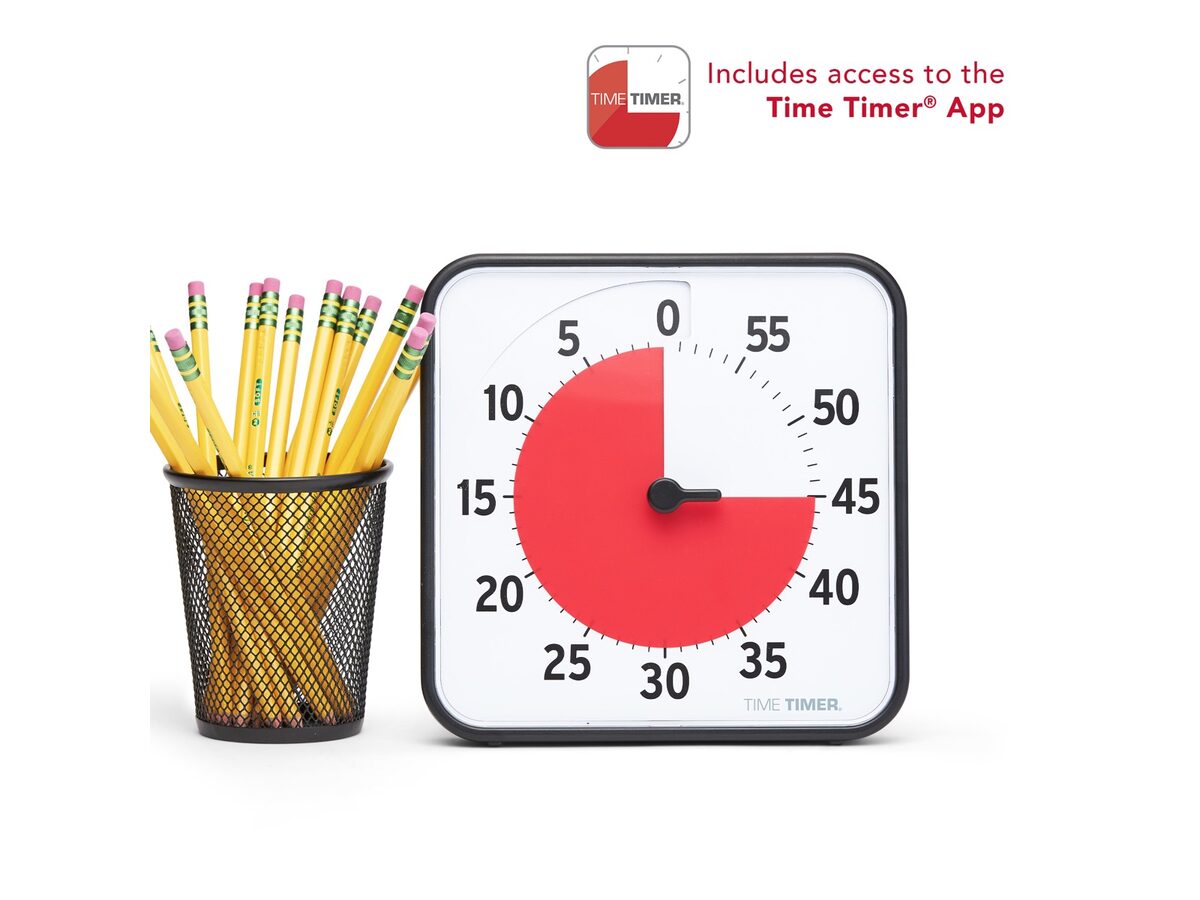
A regular timer beeps at zero and shows numbers while it runs. A visual timer shows the remaining time as a shrinking wedge of color.
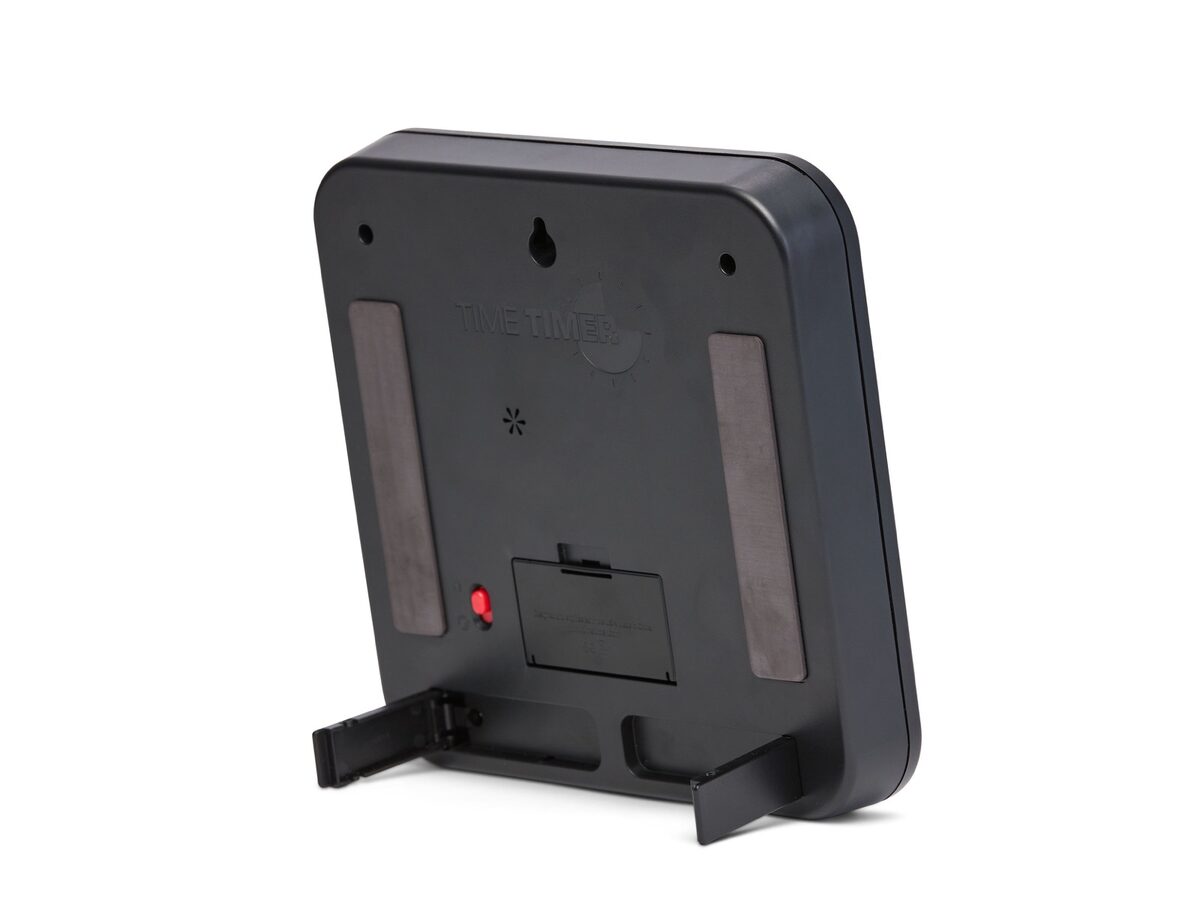
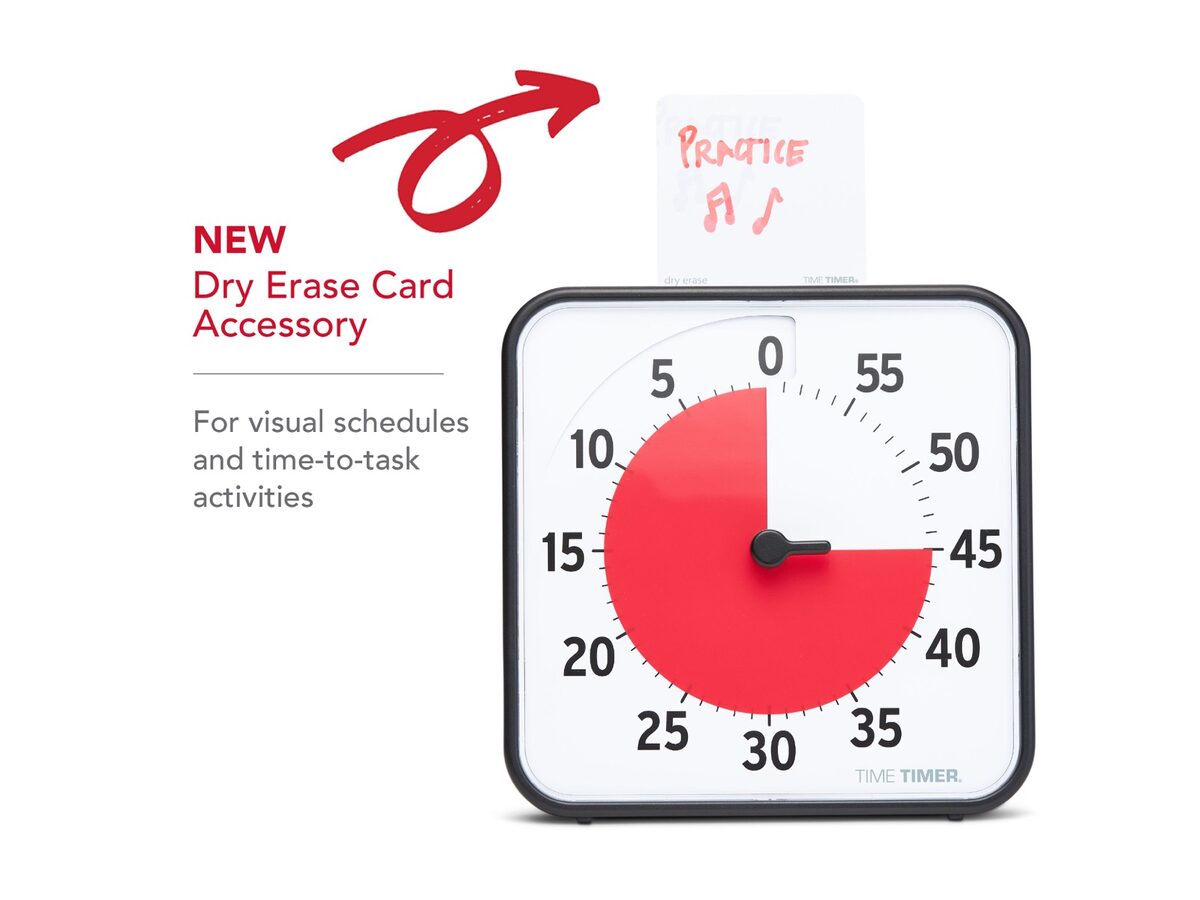
Time Timer is the best known. Its founder, Jan Rogers, created the first one because her youngest child struggled with transitions between daily routines, according to the company's story. Put one beside your monitor and your peripheral vision does the work. When the color's gone, the block is over.
-
Time Timer
Time Timer
Red wedge shrinks as minutes pass—time left at a glance, no mental math on a digital clock.
Time Timer
Time Timer
Red wedge shrinks as minutes pass—time left at a glance, no mental math on a digital clock.
2. Timeline planners instead of flat lists
A to-do list treats "buy stamps" and "draft the annual budget" as equals and hides when anything fits. A timeline planner spreads tasks across the actual hours of your day.
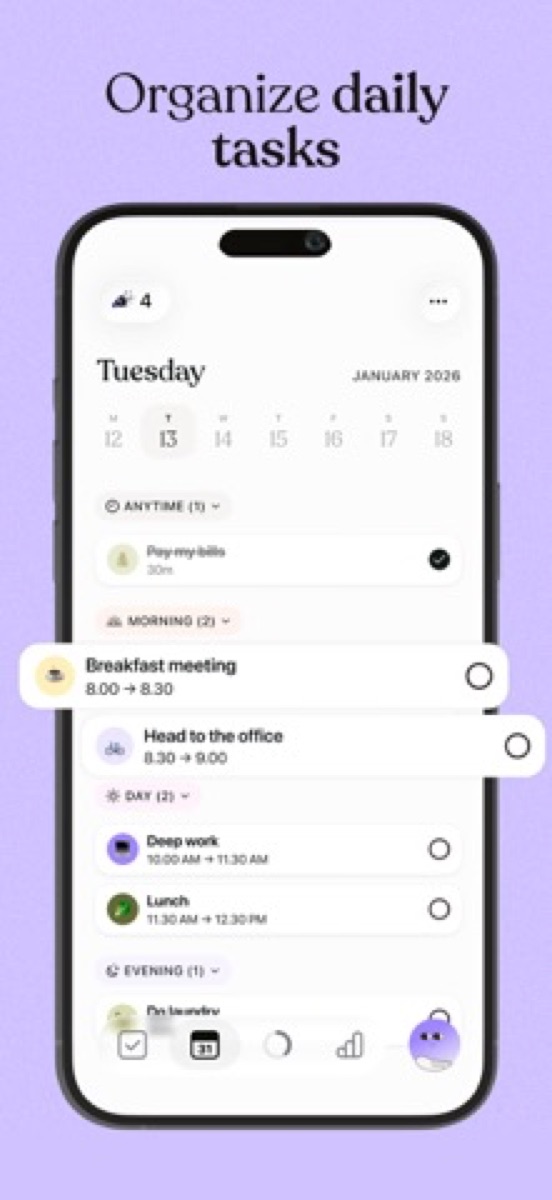
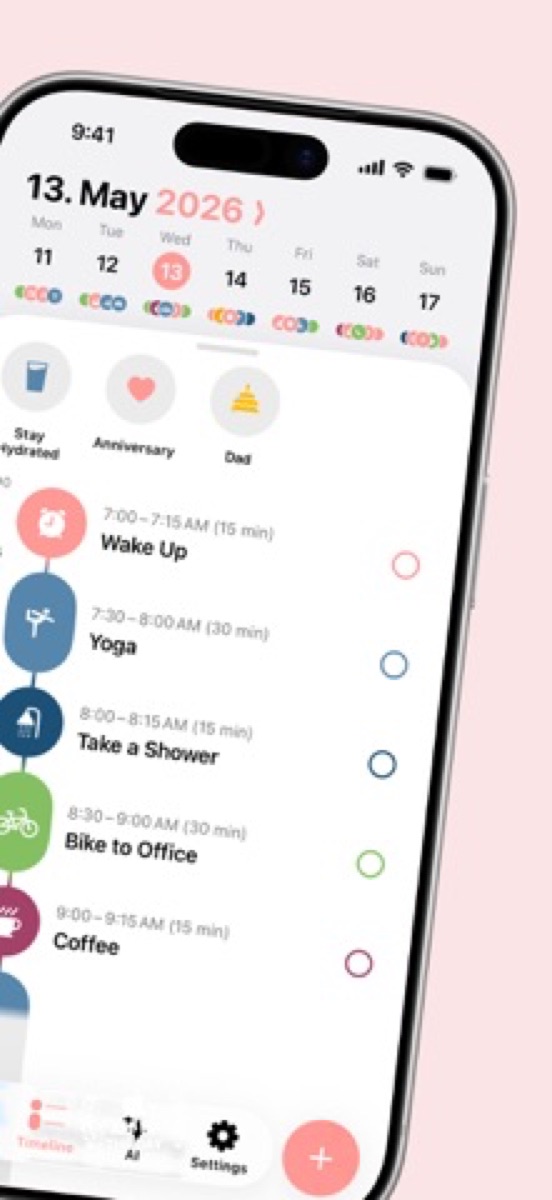
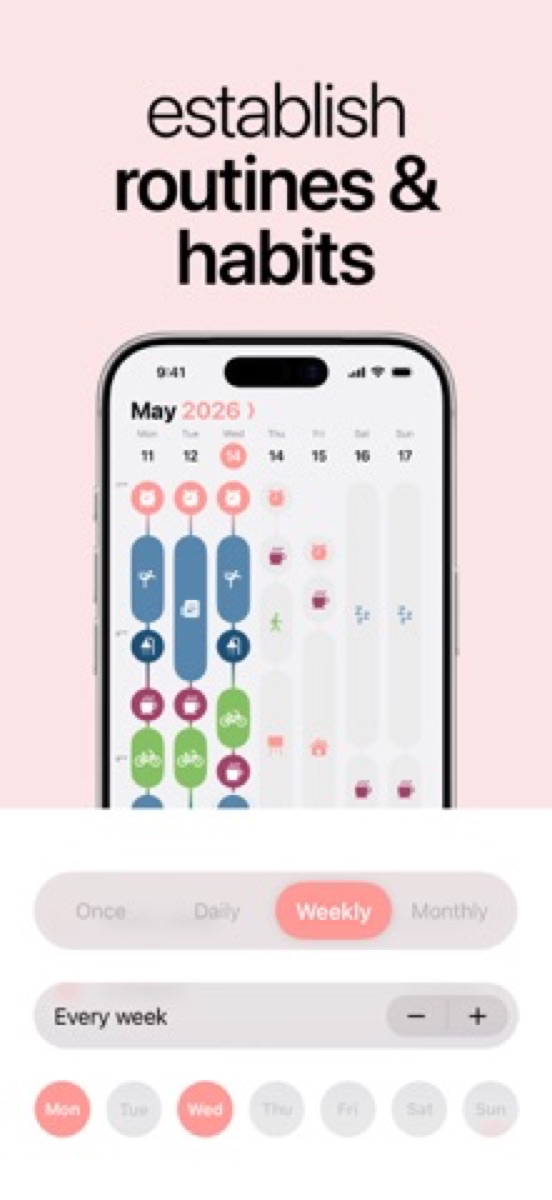
Tiimo is a daily planner built with and for neurodivergent users. It lays your day out as a visual timeline, with each activity as an icon-labeled block and a progress ring, and it includes an AI assistant that splits vague tasks into smaller steps.
-

Tiimo
Tiimo ApS
Color-coded day plan on a timeline—easy to see gaps, overlaps, and how much day is left.


Tiimo
Tiimo ApS
Color-coded day plan on a timeline—easy to see gaps, overlaps, and how much day is left.
If you want something stripped down, Structured puts your whole day on one vertical track. You drag tasks into slots and a live marker moves down the screen as hours pass. It works with Apple Reminders and Google Calendar, which makes the gaps between meetings obvious.
-

Structured
Unorderly
One vertical timeline for today—drag blocks around instead of juggling lists and calendar entries.

Structured
Unorderly
One vertical timeline for today—drag blocks around instead of juggling lists and calendar entries.
3. A wall calendar
Phone calendars disappear when you lock the screen. A wall calendar stays put.
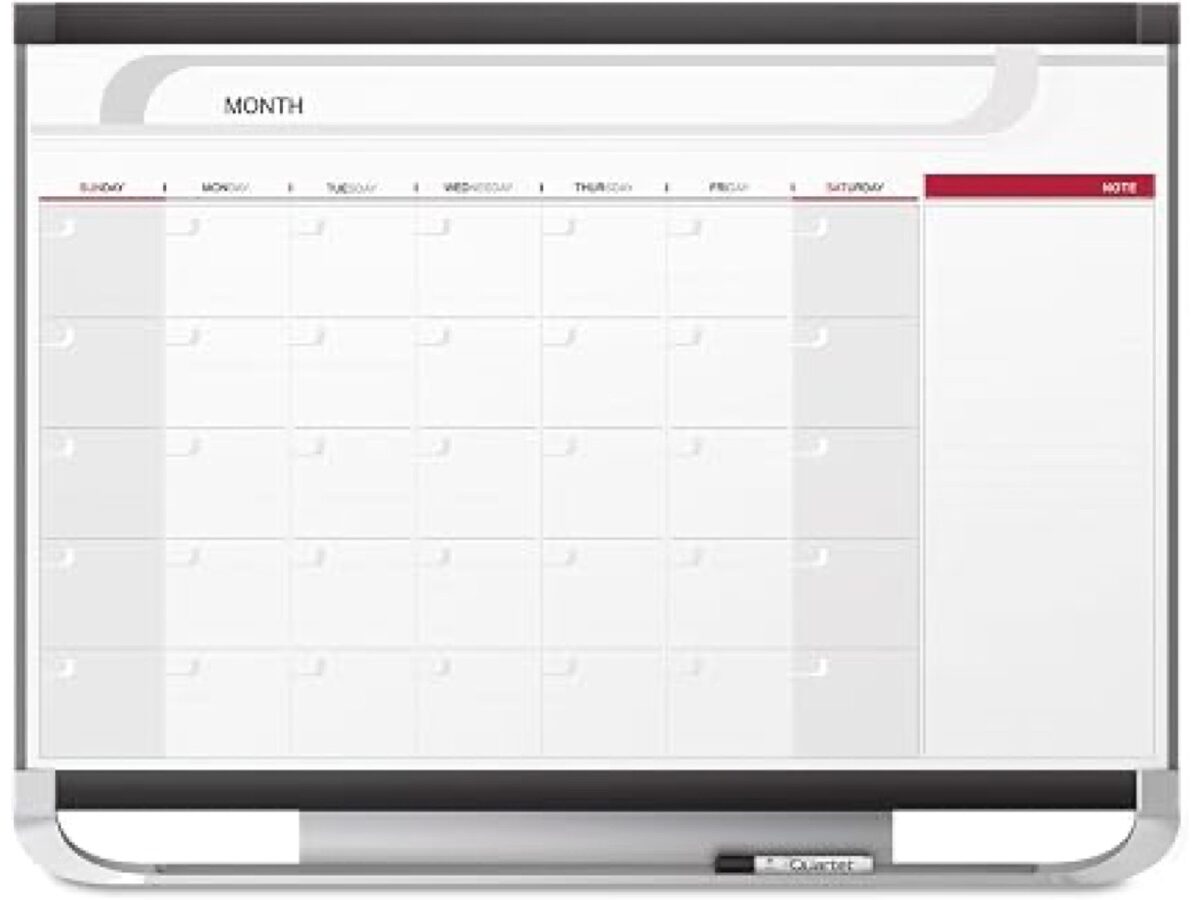
The Quartet Prestige 2 Monthly Calendar Board is a magnetic dry-erase month grid for a kitchen, hallway or office wall. You write plans where everyone walks past, and the month stays in view without unlocking anything.
-
Quartet Prestige 2 Monthly Calendar Board
Quartet
Magnetic dry-erase month grid on the wall—you pass it dozens of times a day, so appointments stay in peripheral view instead of buried in a phone app.
Quartet Prestige 2 Monthly Calendar Board
Quartet
Magnetic dry-erase month grid on the wall—you pass it dozens of times a day, so appointments stay in peripheral view instead of buried in a phone app.
Four habits that make the tools stick
Gear helps. Habits keep it working.
1. Estimate, then check
Your guesses about routine tasks are probably optimistic. For five days, pick three regular activities, say making breakfast, clearing your inbox and the drive to work. Write your predicted time on a card, then time the task with a stopwatch and write the real number. You'll likely find a few surprises, in both directions. Real numbers beat guesses.
2. Use transition alarms, not departure alarms
An alarm set for the moment you need to leave catches you mid-task with no room to stop. Set three:
- Warning, fifteen minutes before: save your files and finish the sentence.
- Transition, five minutes before: shoes on, keys and phone in hand.
- Exit, departure time: walk out.
Label each alarm with the physical action so you don't have to think.
3. Pad your estimates
Assume friction on every trip. If the GPS says twenty minutes, block thirty. For work, if you think a presentation takes two hours, schedule three. Finish early and you get a break. Hit a snag and the deadline survives. A 50% cushion is a rule of thumb, not a studied number.
4. Pair it with body doubling
Timers are easy to silence when you're working alone. Working beside someone else keeps you anchored. Our guide to body doubling for ADHD explains how. If rigid schedules feel suffocating, see these Pomodoro alternatives for ADHD.
FAQ
Is time blindness an official diagnosis?
No. It's a descriptive term, not a diagnosis of its own. It's discussed as a feature of ADHD-related executive function differences, and the 2019 Medical Science Monitor review argues time perception problems may deserve more attention as a characteristic of ADHD.
Can ADHD medication help with time blindness?
Some research suggests it can. In the small Wilson study, timing accuracy improved after medication, and the 2019 review reports that time perception tends to normalize with treatment. Results vary person to person, so talk with a clinician.
How do I explain time blindness to a manager?
Skip the jargon and ask for specifics. Say you work best with visible milestones and checkpoints. Request clear deadlines, break projects into weekly deliverables, and share your timeline during check-ins.
Why do some people with ADHD arrive way too early?
For some, it's a workaround. After years of being late, showing up very early removes the risk of losing track of time in between. It trades hours for peace of mind.
Sources
- Attention-deficit/hyperactivity disorder, self-regulation, and time: Toward a more comprehensive theory (opens in a new tab) – Journal of Developmental & Behavioral Pediatrics, 1997
- Time Perception in Adult ADHD: Findings from a Decade—A Review (opens in a new tab) – International Journal of Environmental Research and Public Health, 2023
- Timing deficits in attention-deficit/hyperactivity disorder (ADHD): Evidence from neurocognitive and neuroimaging studies (opens in a new tab) – Neuropsychologia, 2013
- Clinical Implications of the Perception of Time in Attention Deficit Hyperactivity Disorder (ADHD): A Review (opens in a new tab) – Medical Science Monitor, 2019
- Estimating the passage of minutes: deviant oscillatory frontal activity in medicated and unmedicated ADHD (opens in a new tab) – Neuropsychology, 2013
- Innovative & Award Winning Visual Timer (opens in a new tab) – Time Timer, 2026
- Tiimo: To-Do List Planner App (opens in a new tab) – Apple App Store, 2026
- Structured - Daily Planner (opens in a new tab) – Unorderly, 2026
- Quartet Prestige 2 Monthly Calendar Board (opens in a new tab) – Quartet, 2026
This guide is general information, not medical advice. If focus problems are getting in the way of work, school, or relationships, talk with a doctor or licensed clinician.