Focus
Short-form video attention span: what the science really says
What 2026 research shows about short-form video and attention span, why the goldfish stat is a myth, and practical ways to rebuild your focus.
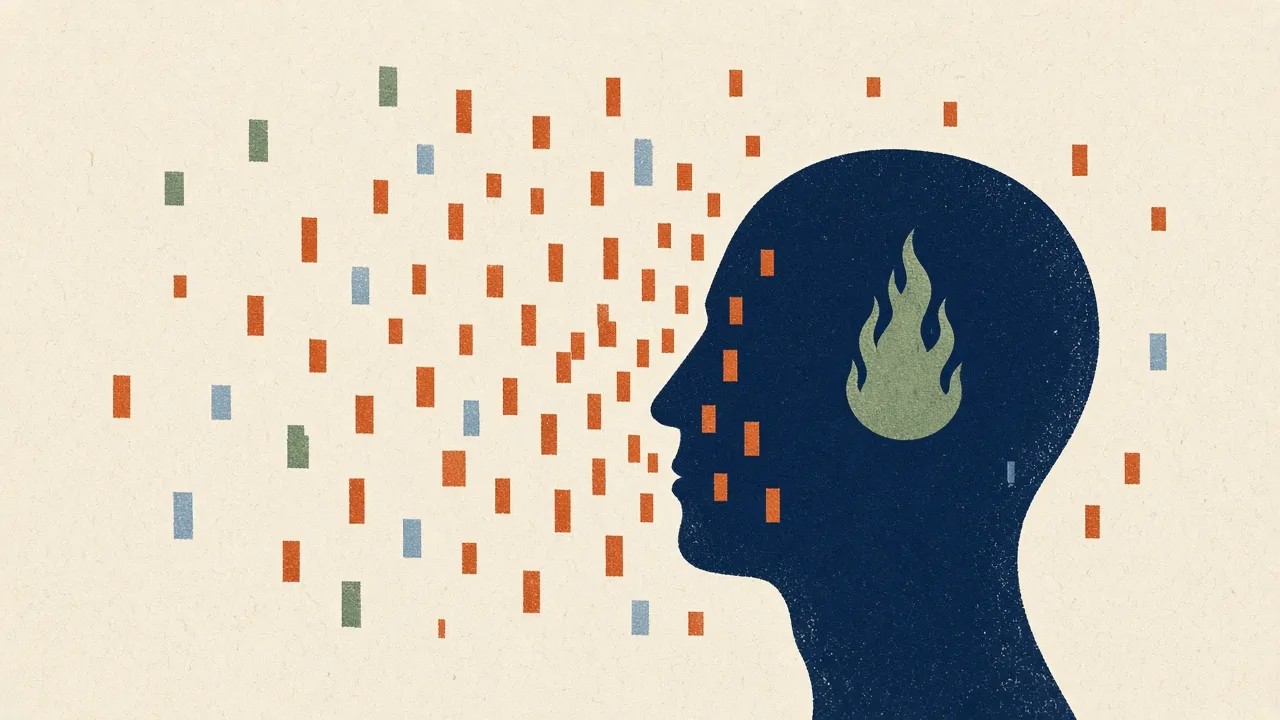
In December 2024, Oxford University Press named "brain rot" its Word of the Year, after use of the term jumped 230 percent in a year. It isn't new. Henry David Thoreau used it in Walden in 1854, complaining that society preferred easy ideas to hard ones. Now it's shorthand for the mushy feeling after an hour of TikTok, Reels or Shorts.
Panic followed. Viral posts say we have shorter attention spans than goldfish. Parents worry teenagers can't finish a book chapter. Office workers notice they click away from a task every minute or so. So does the short-form video attention span problem really exist?
Sort of. The research is more interesting, and less scary, than the headlines. Feeds change how you switch tasks and test your impulse control. They haven't broken human biology.
The myth of the eight-second goldfish attention span
You've seen the statistic. In 2000 the average human attention span was twelve seconds. By 2015 it had fallen to eight, one second less than a goldfish.
It's not real.
It traces to a 2015 Microsoft Canada report. The figure sits in the introduction with a citation to a website called Statistic Brain, not to Microsoft's own research. The BBC contacted the sources Statistic Brain listed, and neither could find any research behind the numbers. Attention researchers the BBC spoke to had no idea where they came from either. Ars Technica followed Statistic Brain's trail to a 2008 paper on how long people stay on a web page after a search, about eight seconds on average. That's a measure of page-hopping, not attention.
The goldfish half is just as shaky. Professor Felicity Huntingford, who has studied fish behavior for almost fifty years, told the BBC that goldfish can do all the kinds of learning described in mammals and birds. They're a model species for memory research for exactly that reason.
And "attention span" isn't one flat number anyway. Dr Gemma Briggs of the Open University told the BBC it's very task-dependent. A student can zone out of a dull handout in two minutes and then play a video game for three hours. Interest, stakes and context decide how long you stay.
What Gloria Mark's research shows about screen attention
The goldfish number is fiction. The change in how we behave on screens is real.
Dr. Gloria Mark, professor emerita of informatics at the University of California, Irvine and author of Attention Span, has tracked screen behavior for about twenty years. In 2004 she watched office workers with a stopwatch and logged every switch. They averaged about two and a half minutes (150 seconds) on a screen before changing.
Later studies used software logging. By 2012 the average was 75 seconds. In studies between 2016 and 2023 it was roughly 47 seconds, with a median of 40. Half of all observed stretches lasted 40 seconds or less before someone opened a new window, checked email or tapped a notification.
Mark doesn't say people's brains have physically degraded. She describes fragmentation. With open tabs, chat pings and a phone next to the keyboard, switching costs nothing, so we switch. The price shows up as stress and tiredness by mid-afternoon.
What recent studies say about short-form video and attention
Short-form feeds are the extreme version of that switching environment: a stream of short clips, each with its own mood, visual style and sound.
The 2025 Psychological Bulletin meta-analysis
The biggest synthesis so far appeared in 2025 in Psychological Bulletin, published by the American Psychological Association. In "Feeds, feelings, and focus," Lan Nguyen and colleagues pooled 71 studies covering 98,299 participants.
What the abstract reports:
- Cognition: More short-form video use went with poorer cognition overall (r = -.34, a moderate effect).
- Strongest links: Attention (r = -.38) and inhibitory control (r = -.41). Inhibitory control is your ability to hold back an impulse and stay on a goal.
- Mental health: A weaker overall link (r = -.21), with stress (r = -.34) and anxiety (r = -.33) the strongest.
- No link: Body image and self-esteem.
- Consistency: Results were similar in youth and adult samples and across platforms.
The authors also note that relatively few studies looked at cognitive areas beyond attention and inhibitory control, such as memory and reasoning. So there are gaps in what we know. And these are correlations. A study that measures people once can't tell you which came first.
The 2025 BMJ Public Health systematic review
A separate review in BMJ Public Health covered 17 studies of adults aged 18 to 29. It found preliminary evidence linking heavier use to attentional fragmentation, markers of lower executive control and emotional dysregulation. The authors warned that most studies were cross-sectional and self-reported, so quality was limited. They suggested the relationship may run both ways: people with existing attention or emotional difficulties may use feeds more.
Correlation versus causation: which comes first?
Does scrolling shrink your attention, or do people with shaky attention gravitate toward scrolling?
Probably both.
If you have low impulse control, high anxiety or ADHD, a short-form feed is a perfect escape. Constant novelty, instant payoff, no setup. Our guide on ADHD or just distracted covers how to tell those patterns apart.
At the same time, hours of rapid switching train a habit. Flick your thumb every ten seconds when a clip slows down and you teach yourself to expect constant novelty. Then a dense report feels painfully slow by comparison. That isn't brain damage. It's conditioning, and conditioning can be reversed. If focus is a daytime struggle, see why can't I focus.
Practical ways to rebuild sustained attention
Attention behaves like a practiced skill, so change what you practice.
1. Run single-task sprints
If you multitask all day, you get good at switching and bad at depth. Try this:
- Pick one task: one section of an essay, one dataset, one chapter.
- Set a physical timer for 25 to 45 minutes.
- Close extra tabs, silence chat and put your phone in another room. Students can find more in studying without a phone.
- Work until the timer ends. If you get an urge to check something, write it on a notepad and keep going.
Expect to want your phone within the first few minutes. Sitting through that itch without acting on it is the workout.
2. Block distractions on every screen
Willpower alone usually fails when YouTube Shorts is one click away.
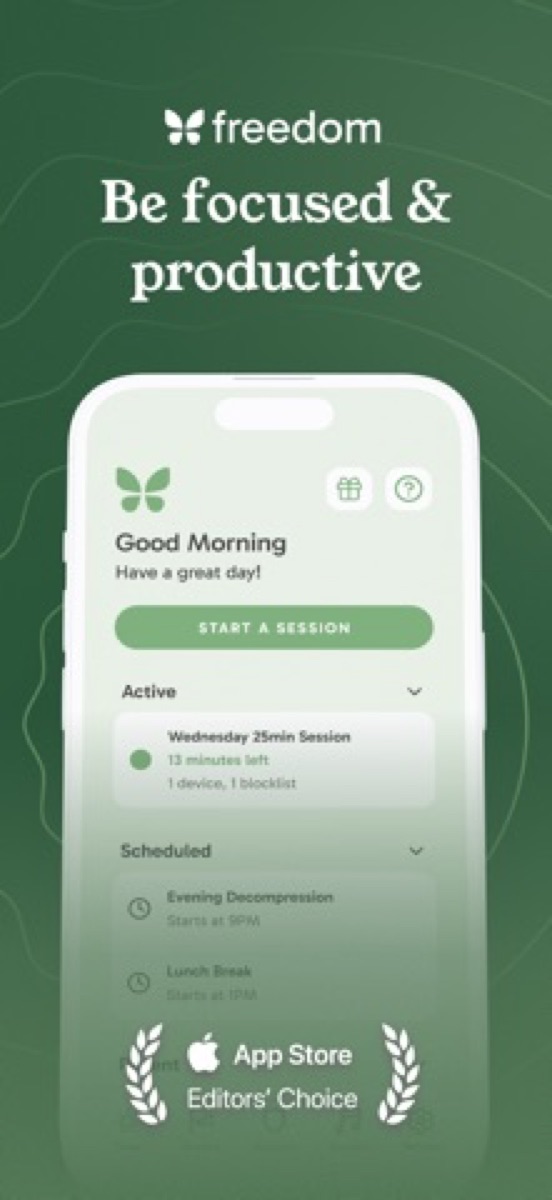
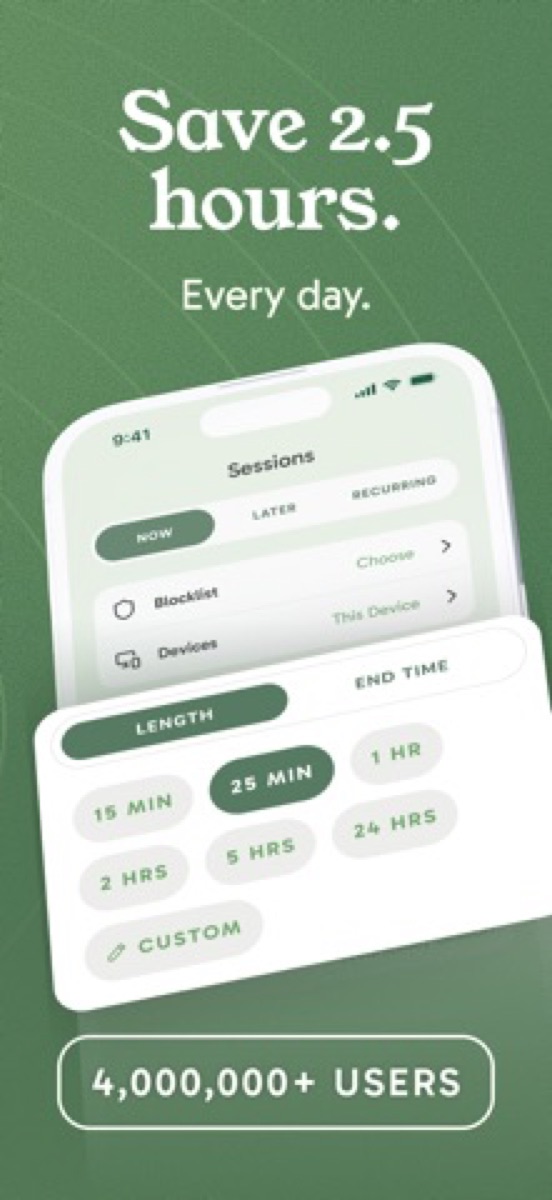
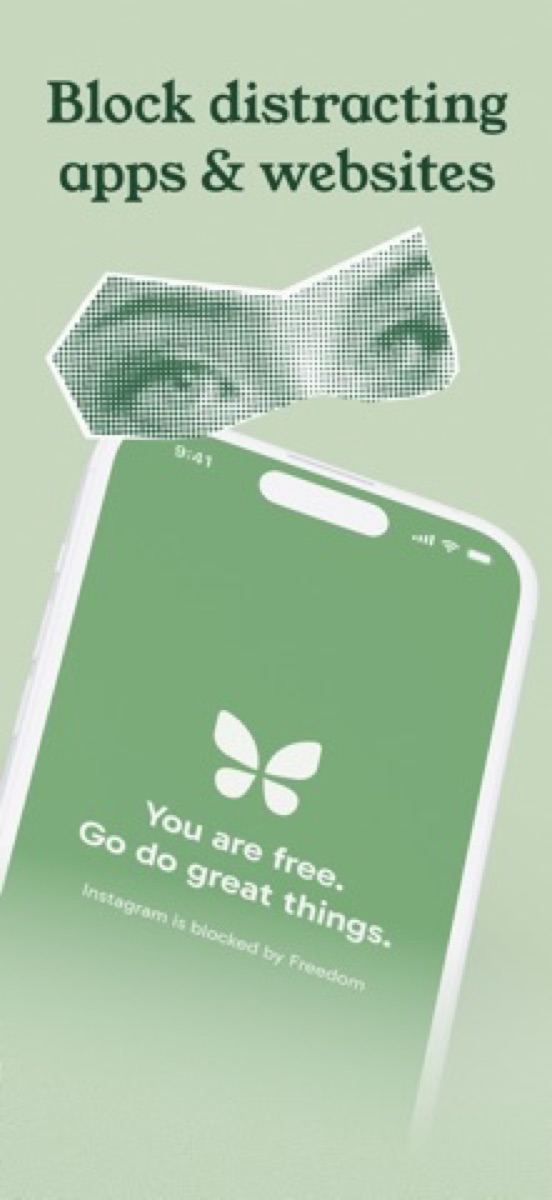
Freedom blocks sites and apps across your devices at once. Its site lists macOS, Windows, iOS, Android, Chromebook and Linux, and says it syncs them. Its Locked Mode prevents you from quitting a session. That matters because the usual dodge is blocking the laptop, then grabbing your phone.
-

Freedom
Freedom.to
One blocklist across Mac, Windows, phone, and browser—start a session and the same sites stay off everywhere.
Freedom
Freedom.to
One blocklist across Mac, Windows, phone, and browser—start a session and the same sites stay off everywhere.
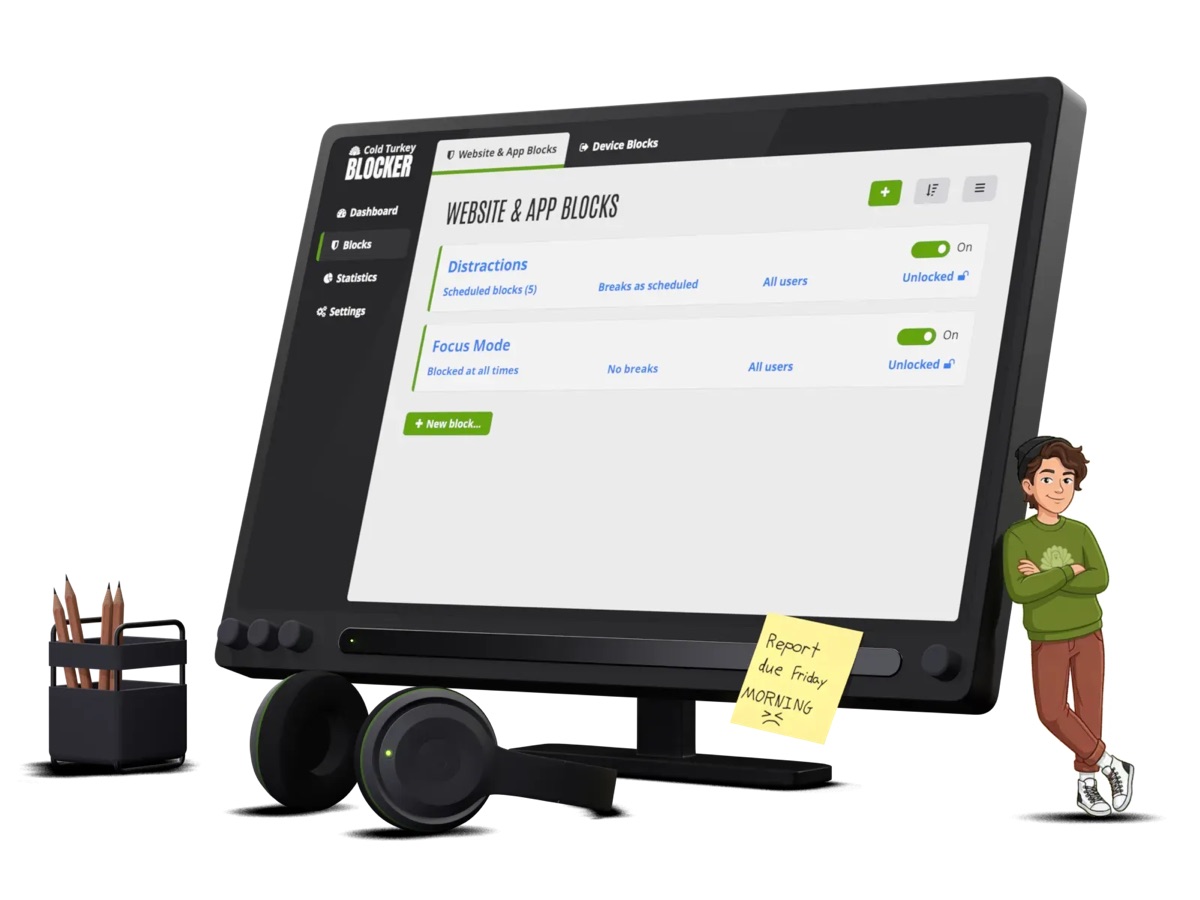
For a computer you want locked down hard, Cold Turkey Blocker is a desktop app for Windows and macOS. It blocks websites, apps, YouTube channels or the entire internet with a few exceptions. Its site says it's almost impossible to stop a block once you lock it, and lists options like schedules, passwords and uninstall prevention. It's a one-time purchase, per the maker, not a subscription. If you tend to negotiate with yourself, that's the point.
-
Cold Turkey Blocker
Fortitude Software
Locks your desktop blocklist until the timer ends, so there is nothing to negotiate.

Cold Turkey Blocker
Fortitude Software
Locks your desktop blocklist until the timer ends, so there is nothing to negotiate.
3. Add some slow media
If your whole diet is vertical clips, the algorithm sets your pace.
Read a paper book. Listen to an album through without skipping. Take a thirty-minute walk without headphones. Watch a whole film without a second screen. Slow media lets you practice enjoying something that doesn't hit you every eight seconds. For breaking the phone loop itself, read why you can't stop scrolling.
FAQ
Does short-form video permanently damage your attention span?
There's no good evidence that it does. A 2025 meta-analysis found that heavier use goes with poorer attention and inhibitory control, but those are correlations, and the studies can't show that feeds cause the differences or that they last.
Where did the eight-second goldfish attention span statistic come from?
It appeared in a 2015 Microsoft Canada report, citing a website called Statistic Brain. The BBC couldn't find any research behind it. Ars Technica reported that the site pointed to a 2008 paper on how long people stay on web pages after a search. Goldfish, meanwhile, learn and remember well.
How long can a person focus on a screen before switching?
In Dr. Gloria Mark's observational studies of office workers, average time on a screen fell to about 47 seconds in studies from 2016 to 2023, with a median of 40 seconds. She attributes that to fragmented environments, not a biological inability to focus.
Can you train your attention span back after heavy scrolling?
Probably, though no study here proves a specific recovery plan. Single-task sprints, blockers, keeping your phone out of the room during focus blocks and spending time with slow media all lower the pull of constant novelty.
Sources
- Feeds, feelings, and focus: A systematic review and meta-analysis examining the cognitive and mental health correlates of short-form video use (opens in a new tab) – Psychological Bulletin, 2025
- ‘Brain rot’ named Oxford Word of the Year 2024 (opens in a new tab) – Oxford University Press, 2024
- Busting the attention span myth (opens in a new tab) – BBC News, 2017
- Why our attention spans are shrinking, with Gloria Mark, PhD (opens in a new tab) – American Psychological Association, 2023
- Short-form video, cognitive and mental health outcomes: a systematic review (opens in a new tab) – BMJ Public Health, 2025
- No, smartphones are not reducing your attention span to less than a goldfish’s (opens in a new tab) – Ars Technica, 2015
- Cold Turkey Blocker (opens in a new tab) – Cold Turkey Software, 2026
- Freedom app and website blocker (opens in a new tab) – Freedom.to, 2026
This guide is general information, not medical advice. If focus problems are getting in the way of work, school, or relationships, talk with a doctor or licensed clinician.